


What can the hundreds or thousands of reviews and social posts surrounding your competitors really tell you?
The amount of customer-generated content from reviews, social media posts, and forum discussions is growing. This material can be a goldmine for competitive intelligence (CI), allowing you to see where competitors excel, where they falter, and how they interact with users.
Types of customer-generated data
You can gather customer insights from all kinds of places: app store and e-commerce reviews, social media posts and comments, online forums and communities, and even user-created blogs or videos. This information might be structured or unstructured, detailed or high-level – but as long as it’s publicly available, it’s fair game.
Social media is full of quick updates, though sometimes the meaning gets lost in slang, typos, or lack of context. Forums and long-form blogs tend to have a lot more detail, even if they take more work to analyze.
One helpful approach for CI is simply noticing what stands out from the norm and digging into why.
It takes a little effort, but it’s worth it. These public posts and reviews act like a digital version of word-of-mouth referrals. And since nearly 90% of people trust recommendations from family and friends more than traditional advertising, the insights hiding in this content can be incredibly powerful.
By analyzing it, you can compare yourself to competitors, understand how customers see different brands, spot common frustrations, and uncover gaps in products or messaging. Looking across multiple data types helps you build a fuller, more accurate picture of where each competitor sits in the market.
Tools and best practices to collect data and see the big picture
To make your CI efforts effective, you'll need the right tools and a plan for using them.
Scraping techniques
To gather review and social data at scale, you’ll need scraping methods that rely on approved data feeds. Many platforms offer APIs or social listening tools, which make pulling this information much easier.
Tools like Bright Data can help automate the collection of structured review datasets across e-commerce and software sites. Apify also offers pre-built scrapers for popular review platforms like Trustpilot, Amazon, and Google Play, letting you pull large volumes of data without ever touching a line of code.
Monitoring mentions
Some teams also use clipping services to track how often a competitor’s brand, products, or features get mentioned. As you monitor these conversations, it’s important to respect user privacy and follow each website or platform’s terms of service.
Plenty of tools can help surface what matters most. For example, Brandwatch can alert you to spikes in conversations about competitors, while Meltwater highlights trending topics, changes in sentiment, and product issues across social channels.
As always, it’s essential to gather CI responsibly. Steer clear of anything that feels like surveillance or crosses into corporate espionage. The most trustworthy insights come from open, public sources – not from invasive or unethical tactics.
Tagging data
In practice, you’ll collect data across different geographies, segments, and platforms, then clean it, tag it with the right classifications, and store it in a central hub so everyone can access it and generate reports. Once your data is consistent, you can start spotting patterns and using those insights to guide product development and marketing decisions.
Tools like MonkeyLearn can help by automatically tagging and clustering text into categories like usability, pricing, or durability – saving you a ton of manual effort. Notion AI can also turn raw data into clear, structured categories, making it easier for teams to spot trends and share what they’re seeing.
Analyzing information
Now that you have the data, it’s time to assess its significance. Natural language processing (NLP) and sentiment analysis allow you to detect positive, neutral, and negative comments about competitor brands and identify patterns in how customers discuss them. You can also learn how sentiment evolves for your competitors' features.
Platforms like Lexalytics offer sentiment scoring and theme detection, pulling out insights that might otherwise get lost in thousands of reviews. Quid is another great option. It visualizes clusters of user conversations, making it easier to see how topics relate to one another and how they shift.
From there, you can use topic modeling techniques, such as clustering, to uncover the main themes. For instance, “durability” might emerge as a top topic. You could then tag competitors accordingly – maybe Competitor A earns praise for “rapid setup,” while “heavy latency” consistently shows up as a weakness. Trend detection can also flag sudden spikes in negative reviews around a feature launch, signaling potential threats to your market share.
You can even build a heat map showing where each competitor sits in the customer perception space by mapping sentiment and topics side by side. Tools like Hotjar, Crazy Egg, and Mouseflow offer additional insight into user behavior by highlighting patterns.
As you interpret all this information, remember that reputation isn’t just about how often a brand is mentioned; it’s about the context. A few negative comments carry a different weight than a wave of them. Ultimately, you’re looking for the insights that reveal where a competitor shines, where they’re falling short, and where you may have an emerging advantage or risk.
How to conduct a CI analysis
Data only becomes powerful when you put it to work. To turn your insights on competitor strengths and weaknesses into something actionable, it helps to follow a consistent, repeatable process. Below are the key steps to guide a strong CI analysis that supports smart decision-making.
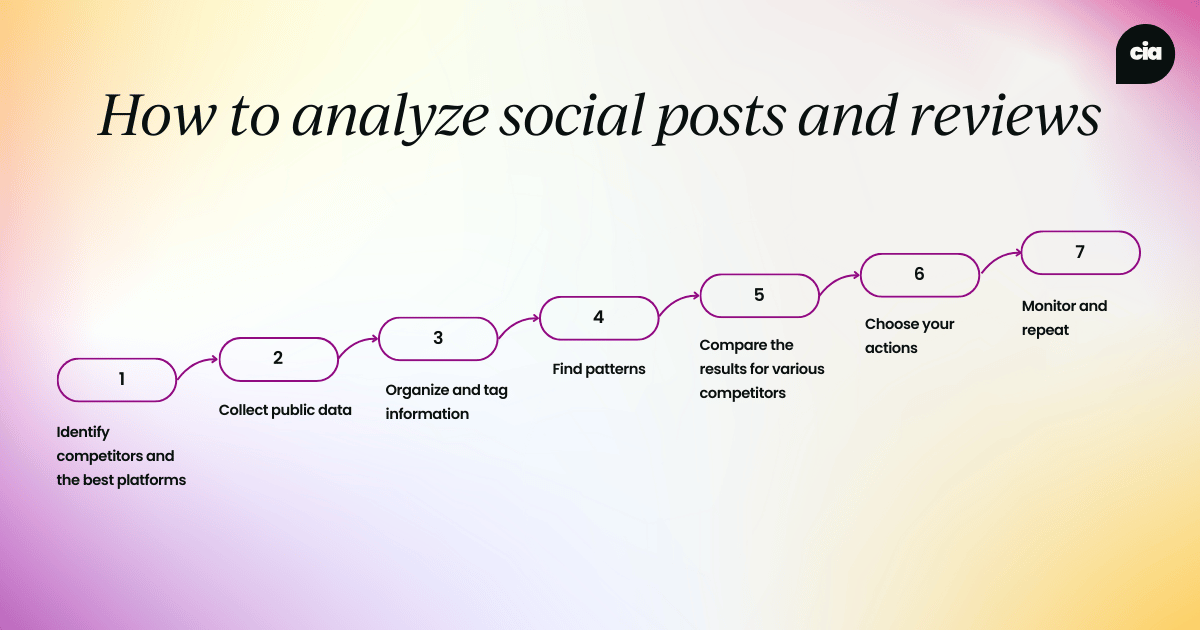
1. Identify competitors and the best platforms
Start by listing the top five to ten companies you consider direct competitors, along with the main channels where customers talk about them – platforms like G2, Trustpilot, Reddit, X, or Facebook groups.
It’s also worth looking at indirect competitors who may not be in your exact space but are shaking things up. The wider your search, the more context you’ll have around overall market sentiment.
2. Collect public data
Pull in reviews, star ratings, and comment threads – just make sure you’re following each platform’s usage rules as you go. Aim for a sample size that’s large enough to give you a balanced view and avoid skewed results.
Your best bet is to try to gather a few thousand comments. You may also filter by geography, product line, or release date to see how feedback changes across different segments or over time.
3. Organize and tag information
This part can be a bit tedious, but it makes a huge difference in the quality of your insights.
Start by removing duplicates, spam, and any off-topic content. Then extract key details like the competitor mentioned, the product feature being discussed, the sentiment, and the review source. Log everything in a simple spreadsheet or CI dashboard. When you standardize your tags, it becomes much easier to spot trends later on.
4. Find patterns
Next, look for repeated themes. If you notice multiple reviews mentioning the same issue – like “slow setup,” “great customer support,” or “poor durability” – that’s a signal worth noting.
Patterns can also show you what customers value most and where their limits are. For example, reviewers might be okay with a slower response time if the product is more affordable. These trade-offs can tell you a lot about what matters most to your audience.
5. Compare the results for various competitors
Now it’s time to stack everything side by side. List out each competitor’s strengths and weaknesses across specific product features, along with the sentiment customers attach to them.
For example, Competitor A might shine in usability but consistently struggle with integrations. Visual tools like heat maps and bar charts make these comparisons easier to digest and help highlight opportunities you can pursue.
6. Choose your actions
Turn your insights into clear next steps. If customers love Competitor B’s transparency, consider how you can bring more authenticity into your own communications. If a competitor is weak on mobile performance, that’s a signal to double down on your app experience.
As you move forward, resist the urge to copy what others are doing. Instead, understand why they excel in certain areas and use that knowledge to strengthen your own approach. Competitive advantage comes from anticipating changes in the landscape, not just reacting to them.
7. Monitor and repeat
CI isn’t something you do once and forget about. Revisit your analysis every quarter or after major product releases to catch shifts in customer perception or spot new players entering the market.
Over time, these repeated check-ins become a living intelligence system that helps you anticipate competitor moves before they happen.
How to apply this analysis
Put your competitor insights to work by identifying new feature opportunities for your product team to explore. Give your sales team the CI they need to handle objections and strengthen their pitches. Use what you’ve learned to fuel scenario planning in leadership meetings so your team stays two steps ahead.
Just as importantly, make sure your organization builds a shared understanding of how to interpret competitor feedback. Strong CI programs guide decisions; they don’t just present numbers. By weaving CI into your regular planning rhythm, your team can move from simply listening to actively shaping change.
Take listening and turn it into leading
Customers are sharing their thoughts every day. The real question is whether you’re listening closely enough.
By bringing reviews and social conversations into your planning, spotting the trends within them, and channeling those insights into your strategy, you unlock meaningful competitive intelligence. With well-organized data and a unified view of customer feedback, you can turn those insights into action.
When your strategy starts with the customer’s voice, you put yourself in a stronger position – one that helps you stay ahead of competitors.

.png?v=4735419d15)