


A few years ago, I built a competitive intelligence (CI) program at Freshworks that fundamentally changed how the company understood and acted on market insights. It was part of a larger 90-day CI launch plan, but one component quickly proved to be the real catalyst: the 30-in-30 interviews.
Spending time with dozens of stakeholders back-to-back gave me an unfiltered view of what was working, what wasn’t, and what people needed most. Those insights became our blueprint, shaping a CI function that was not only aligned with the business but genuinely useful.
In this article, I’m going to show you how we did it.
What are 30-in-30 interviews (and why should you care)?
You might be wondering what 30-in-30 means. Simply put, it means conducting 30-minute interviews with 30 key stakeholders. These interviews became my secret weapon for understanding what our company actually needed from a competitive intelligence perspective.
Why do them? Several reasons, actually.
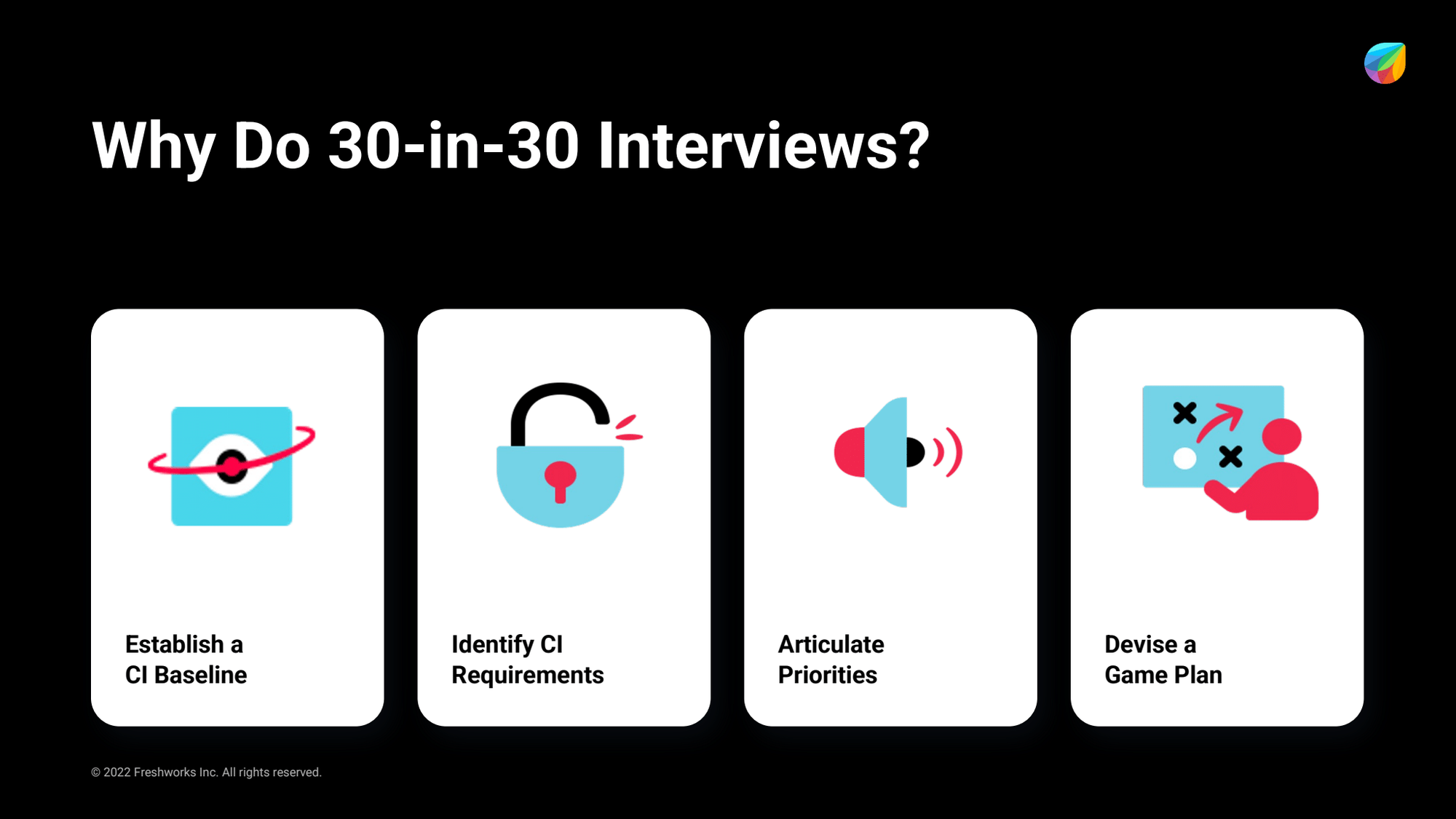
First off, if you're new to a company (like I was) or if you're establishing a brand-new function, these interviews help you establish a competitive baseline. They allow you to get your finger on the pulse of what's really happening in your organization. You can't fix what you don't understand, right?
Second, they help you identify concrete requirements for your CI program – specific, actionable needs that people across your organization are desperate to have addressed.
Third, and this is crucial, they help you prioritize – because let's face it, you can't do everything at once. You need to know what matters most.
Finally, these interviews allow you to build a solid game plan. No more shooting in the dark, just hoping you're addressing the right issues.
When should you run 30-in-30 interviews?
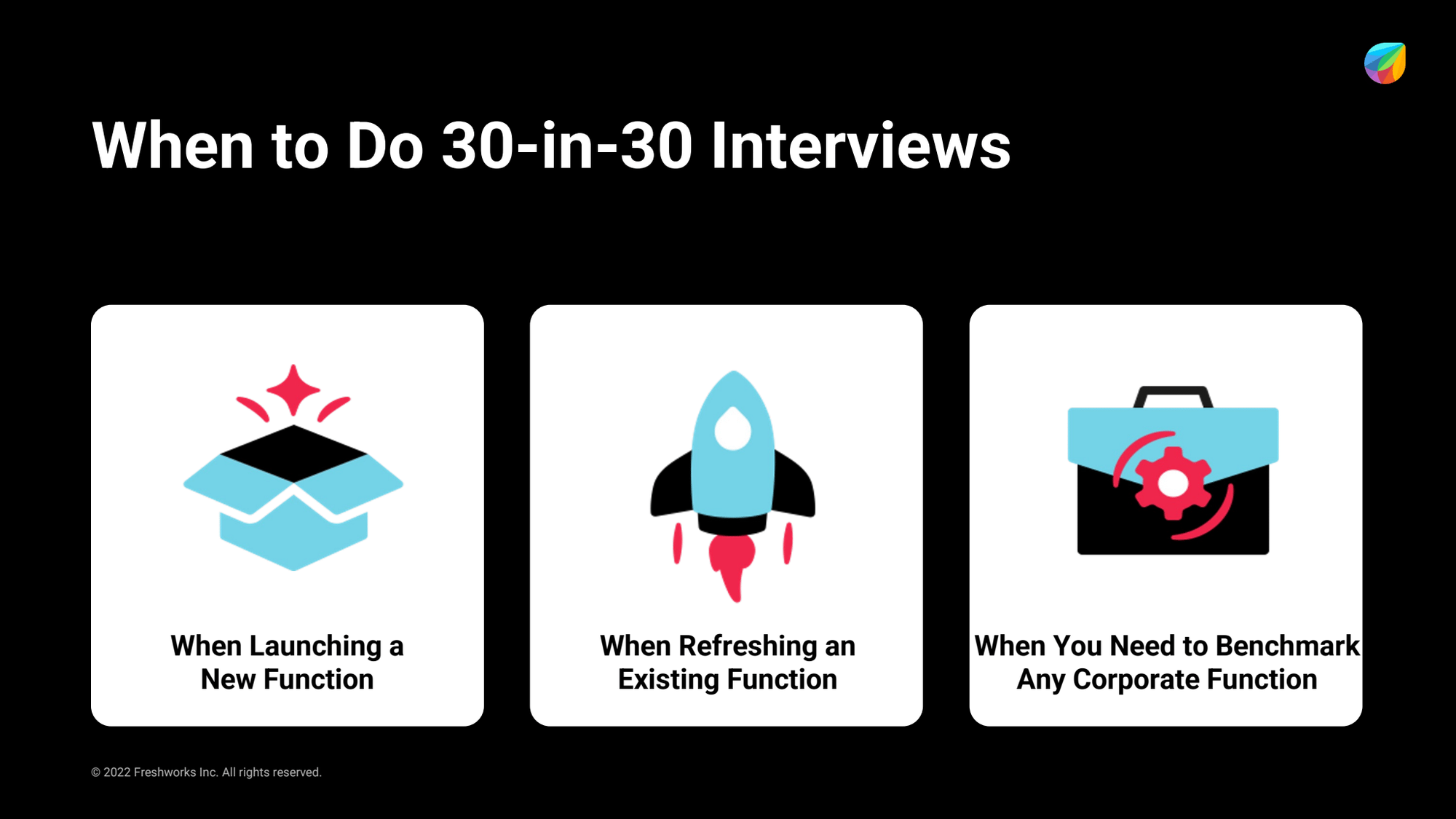
The beauty of this approach is its flexibility. Sure, it's perfect when you're launching a new CI function, but that's not the only time it works. Maybe you need to refresh an existing function that's gotten stale. Maybe you're benchmarking some kind of corporate activity. This framework adapts to your needs.
Who should you interview?
Who you interview matters just as much as what you ask. If you're just starting out, talk to your boss first. Ask them straight up, "Who should I be talking to?" As you get more familiar with the company and start understanding who your stakeholders are, it becomes easier to identify your interview targets.
Save the C-suite for last. By the time you talk to them, you'll have started to spot trends and formulate ideas about what's needed. When you finally sit down with executives, you can share your preliminary findings while gathering their input. It's a much more productive conversation that way.
Six key questions to ask
Whatever questions you choose, use them consistently across all interviews. This consistency is critical because you're going to build out trends based on the answers. You need apples-to-apples comparisons, not a fruit salad of random responses.
Here are the questions I asked in my 30-in-30 interviews at Freshworks:
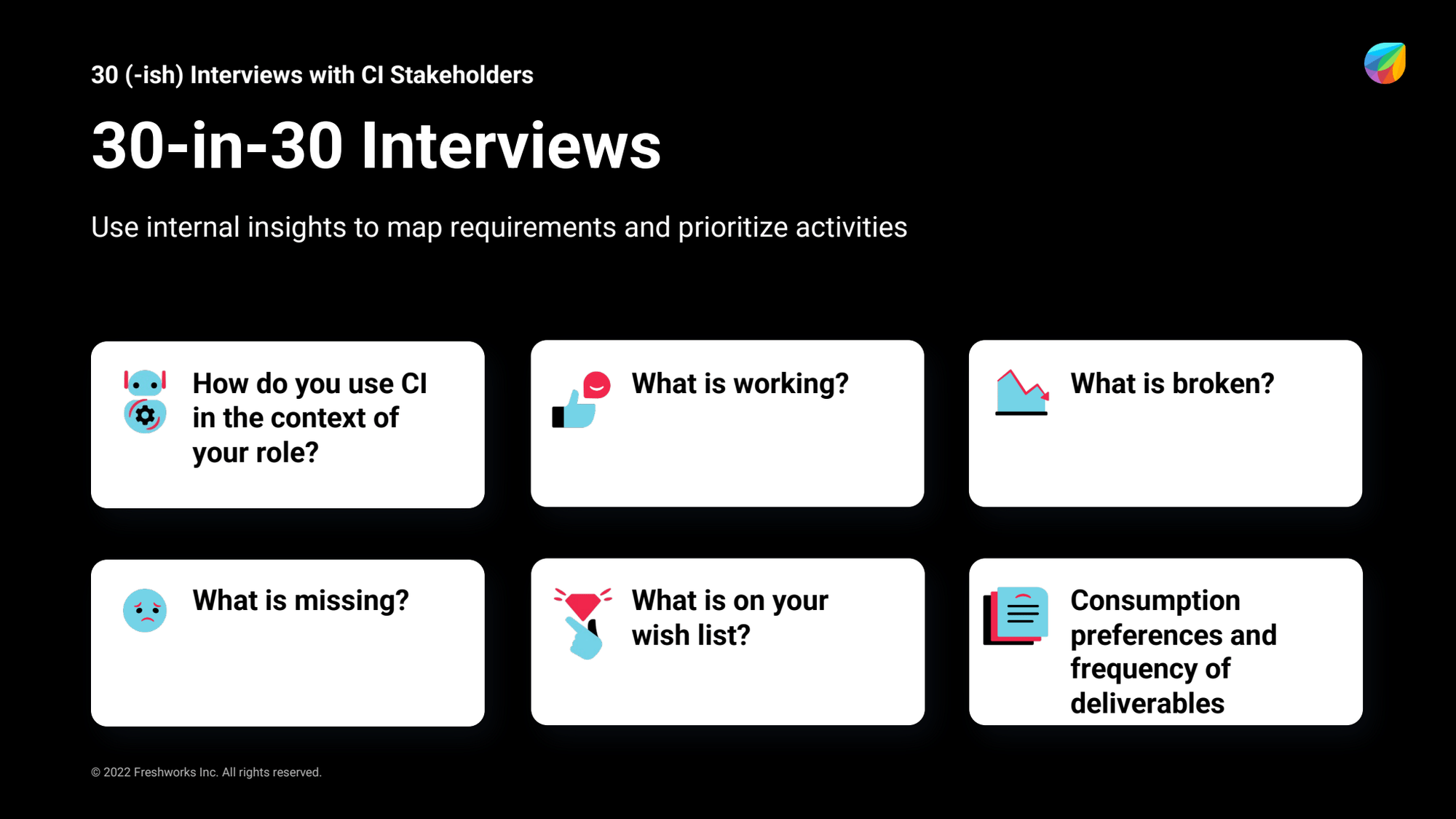
- How do you use CI in the context of your role?
- What's working?
- What's missing?
- What's broken?
- What's on your wish list?
- How do you like to consume competitive intelligence?
Let me break down why each of these questions matters and what I discovered.
1. How do you use CI in the context of your role?
Starting with "How do you use CI in the context of your role?" helps you develop rapport, and more importantly, it provides context for all the responses that follow. You need to understand where someone's coming from before you can properly interpret their feedback.
2. What's working?
At Freshworks, when I asked what was working, the biggest answer surprised me: shared learnings within business units. People were already sharing competitive insights organically within their teams. That's incredibly valuable – it showed we had people who cared about competitive intelligence, even without formal processes.
The next most common answer was CI from new employees. Fresh perspectives on our competitive strengths and weaknesses? Fantastic!
Battlecards and feature function comparisons rounded out the list of what people thought was good about our competitive efforts.
3. What's missing?
This is where things got interesting. The number one answer for what was missing: true product differentiation.
This touched on a sensitive issue at our company. Our competitive intelligence up to that point was being done by product marketers who were asked to take on CI as an additional responsibility.
Now, product marketers are fantastic at what they do, but they tend to look at everything through rose-colored glasses because, well, that's their job. They're supposed to make our products shine.
As a consequence, when they handled CI, it was all about how great we were and how we always win. It didn't address the warts. What people really wanted was honesty – how are we bad as well as how are we good?
Value-driven insights came up repeatedly, too. People were tired of getting facts without context. They wanted the "So what? Now what?" Not just "Competitor X launched feature Y" but "Here's why this matters to you and what you should do about it."
We also discovered gaps beyond the obvious, like the absence of a real two-way CI flow. And perhaps the toughest truth to hear: CI simply wasn’t embedded in our sales DNA. Most reps didn’t yet know how to use it effectively.
4. What's broken?
Now for the really painful stuff. What was absolutely broken in our competitive intelligence efforts?
The number one answer by far: everything was siloed.
Our organization had been around for a while, and in the absence of a formal CI function, everybody was doing their own thing. We had competitive intelligence, sure, but nobody was sharing it across business units. The redundancy was staggering. Multiple teams were researching the same competitors, creating their own battlecards, and duplicating efforts that could have been coordinated.
Our internal portal was another disaster. People just threw competitive information in there and forgot about it. Content from employees who'd left the company years ago was still sitting there. Nobody knew if anything was current or relevant. And good luck finding what you needed! Everything was dumped in with no organization, no tagging system, and no way to separate the wheat from the chaff.
Perhaps most critically, CI wasn't driving our product roadmap. To me, there are two fundamental purposes of competitive intelligence: enabling sales to drive revenue growth and informing product strategy. We were failing at both.
5. What's on your wish list?
After all that negativity, I gave people a chance to dream. "If you could wave a magic wand, what would the perfect CI program have?" The responses were illuminating.
The big theme that emerged was understanding competitors' go-to-market strategies. People were tired of feature-function battles. They wanted to go deeper – understanding our competitors' sales motions and strategies, and get inside their heads. They wanted differentiation beyond those tired old comparison charts with green, yellow, and red boxes.
Tailored battlecards came up a lot. One-size-fits-all wasn't cutting it. People also wanted intelligence on the ankle biters – those emerging competitors, not just the big established players everyone already knew about.
Centralized CI was a common request, along with predictive intelligence. People wanted churn analysis tied to competitive losses. And since we use Slack extensively, they wanted dedicated competitive intelligence channels there.
6. How do you like to consume competitive intelligence?
Finally, I asked how people preferred to consume competitive intelligence and how often they wanted updates. Three major themes emerged:
- Digestible content: No more novel-length battlecards. People wanted bite-sized, actionable insights they could actually use.
- Centralized access: They wanted one place to go for all competitive intelligence, not a scavenger hunt across multiple systems.
- Consultative approach: This one really resonated with me. People didn't just want documents – they wanted a person they could consult with for deal reviews or to strategize about specific competitive situations.
Other preferences included Slack integration (again), curated content rather than information dumps, proper sales enablement, and various other tactical requests. But those top three themes shaped everything we did next.
Using interview findings to build CI program requirements
Now comes the fun part: turning all that qualitative feedback into real program requirements. The process is simpler than it looks – it just takes consistency and a bit of discipline.
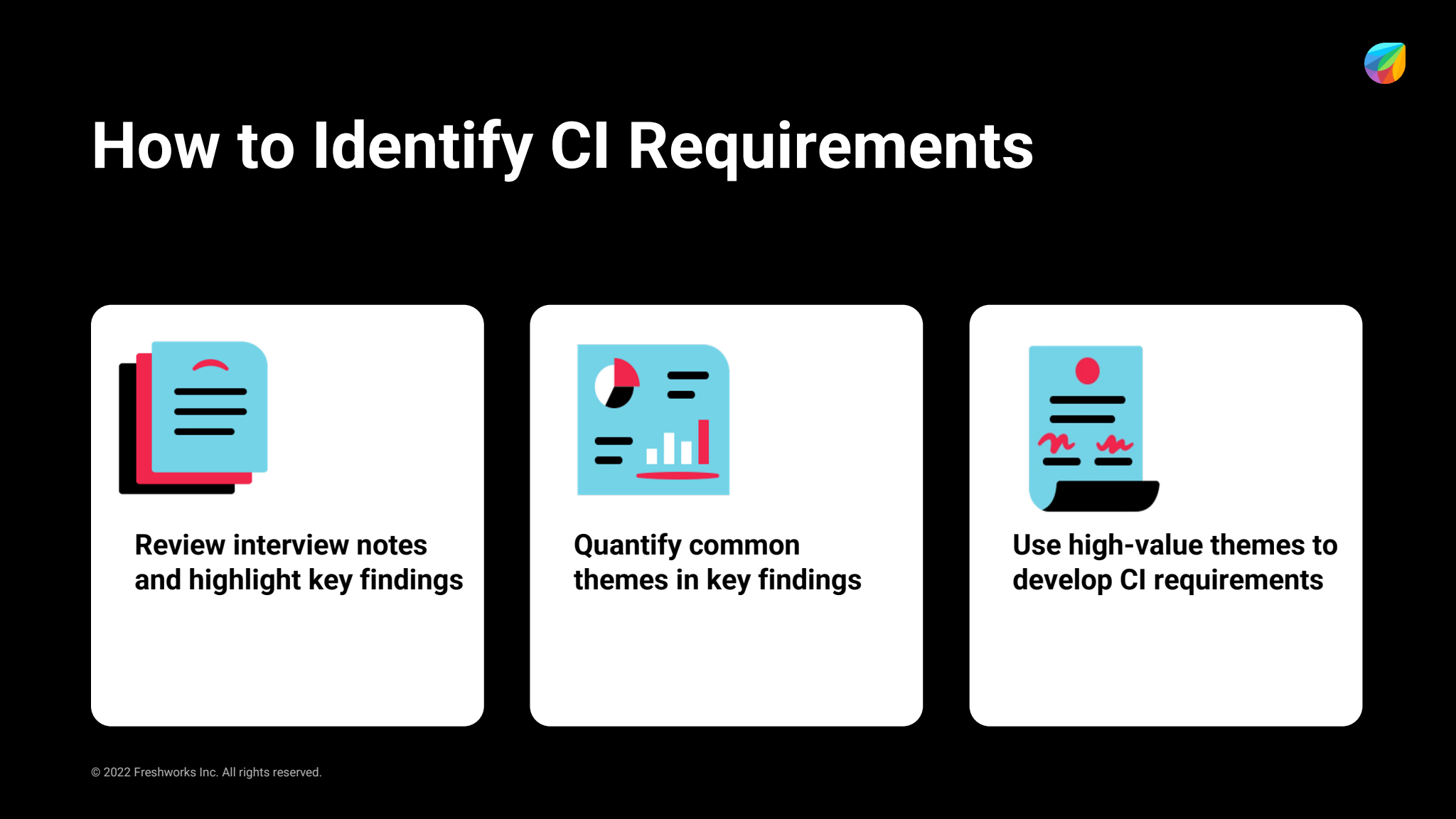
I start by reviewing my interview notes. Yes, some tools can analyze qualitative data for you, but there’s real value in going back through the notes yourself. After 30 interviews, details blur together, and rereading everything helps refresh your memory and sharpen the patterns.
Once I’ve gone through the notes, I highlight the key findings and begin quantifying them. How many people mentioned the same issue? Which frustrations or wish-list items surfaced again and again? Seeing this information side-by-side clarifies what matters most.
From interview insights to actionable CI requirements
After reviewing all 30 interviews, the picture came into focus pretty quickly.
Teams were asking for real product differentiation, fewer organizational silos, and better insight into competitors’ GTM strategies. They also wanted CI that was easy to digest, centralized, and delivered in a consultative way, not just pushed out as static content.
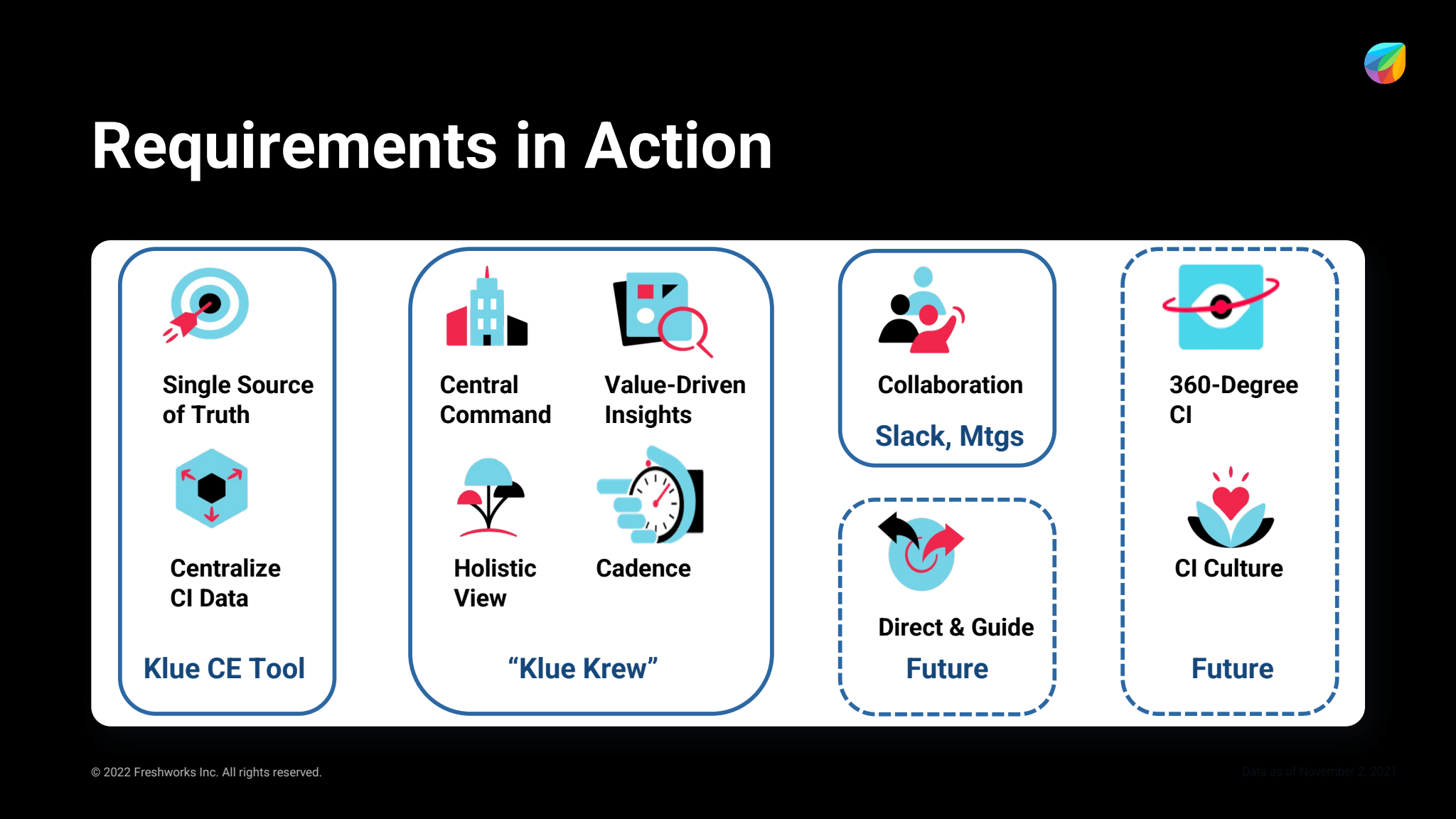
From there, I broke the requirements into two buckets: what the CI function needed to deliver, and what we needed from a communication and engagement standpoint.
CI delivery requirements
- Single source of truth to break down silos and ensure consistent CI
- Value-driven insights with clear “So what? Now what?” context
- Holistic view of competitors beyond feature/function
- Centralized CI data that’s easy to find and supports two-way sharing
- 360-degree CI leveraging customer, partner, and internal touchpoints
CI communication requirements
- Set up a central command to manage CI processes
- Guide stakeholders with a consultative approach
- Maintain a reliable cadence backed by SLAs
- Foster collaboration to keep CI flowing
- Grow a strong CI culture across the organization
From requirements to reality
These prioritized requirements drove everything we did next. They helped us:
- Engage stakeholders properly: We knew exactly who needed what and could tailor our approach accordingly.
- Build the right content: No more guessing what formats or depth people needed.
- Assess our tools: We evaluated what we had versus what we needed to satisfy requirements.
- Plan our budget: I could clearly articulate what resources we needed and what we could deliver with different investment levels. Sometimes you can't say yes to everything, but you can say "not now" and explain why.
- Determine critical involvement: The interviews helped identify when competitive intelligence absolutely needed a seat at the table.
- Establish timelines: I built out a detailed spreadsheet showing what we'd deliver by week and quarter, managing expectations from day one.
How we delivered our CI requirements
Now, let me break down what we did at Freshworks to address all these CI needs.
Competitive intelligence platform
We implemented Klue as our competitive intelligence tool, satisfying our need for a single source of truth and centralized data. The company decided to drive people through our sales enablement tool, Highspot, and the Klue-Highspot integration works beautifully. I'd say 90% of users don't even realize they're accessing a different platform – it's that seamless.
The Klue Krew
We also formed the “Klue Krew,” a decentralized group of product marketers who support CI part-time. While I’m accountable for CI, I don’t manage most of these contributors, but they’ve become invaluable partners, helping expand our competitive efforts well beyond battlecards.
Slack collaboration
Our Slack channel has grown to almost 1,000 members and has become self-supporting. SMEs and veterans now help newcomers with competitive questions. It's not just the CI team anymore – it's a true community.
Direct and guide approach
Advising stakeholders was never a one-and-done task – it was a gradual process of showing up consistently and proving the value of a consultative CI approach.
Over time, that steady partnership paid off. As trust grew, more teams began turning to CI proactively, seeing us as a reliable guide rather than a last-minute resource.
360-degree view and culture
We also invested in building a true 360-degree CI culture – one where insights could flow naturally across teams. It didn’t happen overnight, but little by little, the mindset started to shift. As people shared more, collaborated more, and recognized the impact of collective intelligence, that culture began to take root and sustain itself.
The bottom line
The 30-in-30 interview process gave us something invaluable: a clear, data-driven understanding of what our organization actually needed from competitive intelligence. Not what I thought they needed, not what leadership assumed they needed, but what people on the ground desperately wanted to do their jobs better.
If you're building or refreshing a CI function, I can't recommend this approach highly enough. Yes, it's intense – 30 interviews is no joke – but the insights you gain and the relationships you build make it absolutely worth the effort.
Remember, competitive intelligence isn't about having all the answers. It's about understanding the questions that matter most to your organization and building systems to address them. The 30-in-30 framework gives you exactly that understanding.
So, whether you're launching a new CI function, refreshing an existing one, or just trying to get to grips with what your organization really needs, give it a try!
This article is based on Tracy Berry’s presentation at the Competitive Intelligence Summit, New York. At the time of giving this presentation, she was the Director of Competitive Intelligence and Communication at Freshworks. She’s since taken on a new role as the Principal at Berry Insights.

.png?v=e1d7b48caf)