



What is a niche market advantage?
A niche market advantage is a type of competitive advantage - one that stems from targeting and winning a small portion of a larger market. At its core, this is the direct opposite of a mass market, or “undifferentiated”, marketing strategy.
Rather than commoditizing your product, you’ll make it super high value for a small number of people, rather than low value for many.
In his (now classic) book, Competitive Advantage, Michael Porter lays out several what he calls “Generic Strategies” for obtaining a competitive advantage. These are:
- Cost leadership strategy.
- Differentiation strategy.
- Focus strategy.
This last one, the Focus strategy, is niche market strategy. With a Focus strategy, a business wins its competitive advantage by meeting the unique needs of a specific, small market segment. It aims to solve these needs better than any competitor (if any true competitors even exist in this unique space).
So, if your business wins a niche competitive advantage (via a niche differentiation strategy, for example) but you’ve no competitors, who can you be said to have an advantage over?
Even the most unique products serve a similar function to something that’s gone before. When you dig deep enough, new and disruptive businesses offer the same core, emotional creature comforts as their predecessors.
For all its innovation in delivery, Netflix offers entertainment. Quite different in form, but quite the same in function (at the emotional level) to a 19th-century storyteller in a Victorian public house.
What is a competitive niche?
A niche is a smaller market segment within a larger audience. This segment has specific needs, buying behavior, and lifestyle characteristics.
By investing in customer research and learning all about these specific needs, behaviors, and characteristics, you can tailor your products to meet the particular wants and needs of your niche.
A ‘competitive’ niche is highly contested, so it has less profit potential than one with fewer competitors.
Renée Mauborgne and W. Chan Kim’s “Blue Ocean Strategy” suggests targeting an uncontested portion of the market. It urges you to create your own sub-space in the market that competitors haven’t yet been innovative enough to discover or create for themselves.
How to evaluate whether a niche is “worth it” before you commit
Before committing resources to a niche, it’s critical to assess whether the niche offers enough opportunity to justify investment — and whether it’s a good match for your business.
Key criteria to evaluate a niche
- Market size and growth potential: A niche should be small enough to avoid massive competition, but large enough (or growing) to allow sustainable revenue. If the niche is static or shrinking, you risk running out of customers or demand.
- Purchasing power and customer willingness to pay premium: Often, niches succeed because customers value specialization and are willing to pay more (e.g. “specificity pays”).
- Level of unmet needs or pain points: The niche should have genuine problems or desires that are under-served by existing offerings. The stronger and more specific those needs, the more defensible your niche positioning.
- Competitive intensity / number and strength of rivals: Part of a niche’s appeal is reduced competition. If the niche is already crowded with strong players, the advantage is lower. A “competitive niche” (i.e. many rivals) reduces profit potential.
- Fit with company resources, expertise, brand identity: Niche strategies often make sense when you have relevant expertise, or when you deeply understand the audience (e.g. as a founder belonging to that niche).
Decision framework: Quick “Go / No-Go” checklist
| Question | If “Yes” — good sign | If “No” — warning sign |
|---|---|---|
| Is the niche underserved / under-served currently? | High chance to differentiate | Likely commoditised / saturated |
| Can you reliably reach and engage this audience? | Easier to target & build trust | High acquisition cost, weak ROI |
| Are customers willing to pay for specialization? | Better margins, sustainability | Compete mainly on price → thin margins |
| Do you have the expertise / resources to deliver specialized value? | More credible, defensible offering | Risky delivery, poor differentiation |
| Is the niche large or growing enough to sustain business? | Growth potential, scalability | Risk of stagnation or too small a market |
Putting a disciplined evaluation process before committing helps avoid common pitfalls — especially over-concentration on a too-narrow niche that can’t sustain long-term growth.
Advantages of having a niche competitive advantage
So, of all the strategies for creating a more profitable business, why might you choose a niche competitive advantage?
Viable for small businesses
For starters, targeting a small niche is well within the capabilities of most businesses, no matter their size.
This is especially true when the founder is a member of the niche they’re targeting.
Rather than having to invest in detailed customer research, the founder, as a member of the niche themselves, intimately understands all their target audience’s pain points and problems.
This makes them uniquely qualified to create and sell a solution.
Second, setting its sights on a small niche allows a small business to focus its limited resources on winning in one area.
It’s often difficult for a small business to focus on larger sections of the market. That’s because marketing to larger audiences requires more capital and a more complex and costly marketing strategy. Two things that are beyond the financial reach of many small businesses.
Focusing on a small subset of the market, on the other hand, increases the chances of making a lasting impact on a significant enough number of people to turn a profit quickly.
Eliminates competition
Targeting a very specific niche eliminates much of the competition. Done right, there’ll be few, if any, competitors pouring resources into creating products to solve the same specific problems as you.
This is the heart of Renée Mauborgne and W. Chan Kim’s “Blue Ocean Strategy” we mentioned earlier. By positioning your brand to fill a space where there are no “sharks in the water”, you give yourself room to grow unimpeded.
What’s more, when prospects discover your brand, you’ll seem fresh and unique. There’ll be little on the market to compare your brand with because there aren’t any other businesses delivering a service quite like yours.
 Alex Walton
Ensures relevance
More focused marketing strategies ensure you’re relevant to your target audience. It’s crucial your brand messaging and storytelling makes it clear who your product is for and why it solves their problems better than any other product out there.
When you’re dialed in on one or two key problems, distractions are impossible. You’ll end up doing more of the few things that work, enabling you to iterate quickly and get to the right solution for your customers in record time.
Your marketing campaigns can’t help but appear fresh and striking to prospects, either, as they’re written by a team that understands prospects’ needs inside out. This leaves prospects feeling confident your product is right for them.
Even the simplicity of a small product line, too, can help break down buyer resistance, easing the sales process.
Specificity pays
Businesses can set higher prices for specificity.
Think “business strategy consultant for solopreneurs in San Francisco”. How much do you think this person could get away with charging their clients?
Compare that figure with what you think they could charge for a generic “business strategy” call.
Due to greater specificity, customers trust that the vendor understands their specific needs and problems. They’re more willing to pay higher prices for this extra confidence.
There’s a lot of value to be found in reducing risk and uncertainty for prospects, and this specificity is one of the ways businesses can do just that.
Alex Walton
Disadvantages of niche market strategies
Small margin for error
Going after a niche market is a double-edged sword.
It’s the business equivalent of putting all your eggs in one basket and the opposite of “diversifying your portfolio”. As a result of doubling down on a few specifics, you’re exposed to a lot of risk with very little room for error.
Niche markets are “high risk, high reward” opportunities. Do things well, and the rewards are magnified. Put a foot wrong (especially if you don’t have the financial resources to absorb the costs of mistakes), and it’s the consequences that are magnified.
This is another reason it’s so beneficial when your founder is a member of the very audience you’re targeting. They’ll know which problems to solve first, how to prioritize, and where to advertise to get the word out to relevant audience members.
Churn has more impact
With such a small audience, your profit margins ride on a small number of high-value sales, rather than a high number of lower-value sales. From there, it’s all about retaining those customers and driving brand loyalty.
Since customer acquisition costs are high, small fluctuations in churn rate can make a massive impact on your bottom line. Each sale is hard-won, so when you lose a customer, you’re going to feel it.
You’ll also more keenly feel the disruption when (not if) competitors and imitators start to muscle in on your small market space.
How to turn a temporary competitive advantage into a sustained one with the VRIO framework.
Hard to apply economies of scale
Niche market strategies don’t lend themselves well to economies of scale because there aren’t many willing buyers (the relevant target market is small).
Take cars, for example. The first (and perhaps greatest) example of using economies of scale to turn a profit.
In the early 1900s, cars were still assembled by hand. This made them a luxury product, out of reach for the many. Henry Ford took something that, per unit, was horrendously expensive to make and for consumers to buy. He invested in manufacturing processes, multiplying efficiency, slashing costs, and ramping up production.
The result? The cost of his motorcars fell almost 70%. Production increased accordingly. With greater supply, and affordable products, cars became available for the masses to purchase.
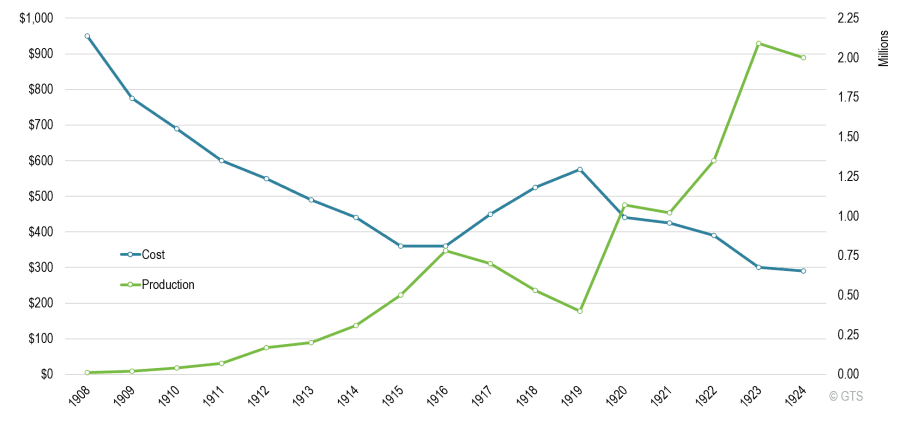
Ford commoditized what was a luxury, but only for his cars. Competitors produced cars that were little better for many times the cost. With this strategy, Ford used economies of scale to create a Cost Leadership Advantage (aka, a cost competitive advantage), as Michael Porter would put it.
This makes clear just how at odds it is to target a small section of the market and try to apply economies of scale. Economies of scale work wonders when you’re producing a commodity for the many. Especially when you’re taking a once-luxury product and making it affordable.
The crux here is that everyone benefits from transport. It’s a universal need. The specific problems you purposely set out to solve don’t have this scope, so selling on the scale necessary to make economies of scale viable becomes near impossible.
How to research and analyse a niche market: Tools and metrics for competitive intelligence
To successfully implement a niche competitive strategy, you need data: real insights about customers, demand, competitors, and market dynamics. For competitive intelligence professionals, this means building a robust “niche analysis” process.
What to analyse: Key variables
- Customer demographics, psychographics, behaviour: Who are they? What are their values, pain points, motivations, habits? Segment beyond basic demographics to understand lifestyle/needs.
- Demand size and growth trends: Historical and projected growth; adjacent markets; potential for expansion.
- Competitor landscape – direct and indirect: Who else serves this niche? Are there close substitutes? What’s their offering, pricing, strengths/weaknesses?
- Pricing sensitivity and willingness to pay: Are customers seeking high-value, premium offerings? Are they driven by price, convenience, specialization?
- Barriers to entry and differentiation factors: What makes the niche defensible (specialized knowledge, brand trust, unique features, regulatory or technical barriers)?
Suggested methods and tools
- Customer interviews & surveys: Primary research — ask target-niche users directly about their unmet needs, frustrations, priorities.
- Secondary data sources: Market reports, industry studies, public data, social-media listening. Identify demand trends, potential niche growth, and competitor activity.
- Competitive benchmarking: Map out existing players — their positioning, pricing, strengths and weaknesses. Use frameworks like the 3Cs model (Company, Customers, Competitors) to structure analysis.
- Value-proposition mapping: Evaluate whether your offering delivers a unique value (quality, specialization, convenience) over alternatives. Use the lens of Customer Value Proposition to assess pricing vs. benefits.
- Scenario modelling: Run best-case, base-case, worst-case forecasts for customer acquisition, churn, lifetime value — especially crucial given niche size limits (small audience → high churn impact).
By systematically analysing these variables — rather than relying on intuition — competitive-intelligence professionals can give decision-makers a solid foundation for whether a niche is viable, defensible, and strategically sound.
Niche advantage case studies
It’s not hard to spot a business with a niche competitive advantage.
They’ll be attentive to the specific needs of their specific target audience, and there’ll be tell-tale clues sprinkled through the brand messaging and storytelling. They’ll use language that aims to convince prospects their specific needs are about to be solved. All they need to do is buy.
Quorn
British food company Quorn’s line of vegetarian and vegan meat substitutes aims to look and taste like the real thing.
This immediately tells you they’re a brand looking to solve specific problems for specific people. Vegetarians and vegans are already two subsets of the market, but not all vegetarians or vegans want a ‘substitute’. Many dislike the taste of meat, or the texture.
It does, however, position Quorn’s products as a happy compromise. This made Quorn products a hit with families where the resident cook had to please a family of mixed opinions when it came to whether meat was in or out.
Their existing brand messaging is devoted to sustainability and the health of the planet. This, too, is an attempt to target a niche audience, this time segmented by its environmentally-conscious values.

Remote
A service for businesses that are serious about making remote work work.
Rather than position itself as a platform for payroll, HR, and employee benefits for every business, Remote positions itself as the best solution for businesses with a distributed workforce.
Remote understands that, when your staff is spread across the globe, there are particular concerns around trust, security, and the ease of taking care of bulk tasks like payroll in myriad currencies.
As such, their brand messaging reflects ease and safety, with words like “safeguard” and “streamline” featured prominently on the homepage. The tagline “Grow your team the right way with Remote”, meanwhile, makes it clear this is a service for scale ups looking to hire the best talent - wherever it’s found.
Google Stadia
Here’s an example of a niche product from a well-known company - only this time, the product didn’t pan out.
Google recently announced its plans to discontinue its Stadia gaming service and refund all purchases, but its stint in cloud gaming is an excellent example of an attempt to capture a niche portion of the market.

Brand messaging focuses on ease, with the tagline “skip signup and just play” still visible on the website.
Even non-gamers have heard of Playstation, XBox, and Nintendo. This trio of industry giants has been battling it out for market share for decades.
But what about those who can’t afford expensive consoles? Or those who can’t access them? What about those dreaming of a simpler gaming solution?
Google aimed to bring gaming to these individuals and solve a specific problem: how do you provide a high-quality gaming experience with little or no hardware?
With Google Stadia, all users needed was a decent enough WiFi connection, a compatible controller, and a Chromecast Ultra. This brought the price of entry for a 4K gaming experience down to around $100.
Sadly, the service didn’t take off as Google had hoped. Stability issues, a lackluster library of games, and a lack of consumer trust all forecast the service’s downfall. But by targeting a subsection of the gaming market, Google created a viable new cloud gaming service that it plans to license to third parties.
How to make niche competitive advantage sustainable – Avoiding short-term “fads”
A niche strategy can be powerful, but only if treated as more than a one-off experiment. Many businesses fail to sustain their early advantage, especially if the niche is poorly defended or cannot scale. Here’s how to make niche advantage durable.
Common risks / pitfalls
- Over-reliance on small audience → volatility: With narrow customer base, small changes in demand or churn can disproportionately hurt revenue.
- Inability to reap economies of scale: Niche markets rarely allow mass production efficiencies or cost-leadership strategies.
- Competitive encroachment or imitation: Once a niche proves profitable, larger players may enter, eroding margin.
- Niche saturation or stagnation: If customer needs evolve or the niche becomes mainstream, your specialization may lose value.
Strategies for longevity and adaptability
- Build brand loyalty and community around niche: Deep relationships, customer trust, and credible positioning make churn less likely. As niche customers value specialization and trust, delivering consistent quality builds defensibility.
- Create expansion paths — adjacent niches or “niche layering”: Once you have momentum, identify related niche segments or sub-niches to expand into — broadening your scope without abandoning the specialization mindset.
- Continuous innovation & product/service differentiation: Keep enhancing your offering to stay ahead of imitators or shifting needs. Use feedback loops, customer insights, and incremental improvements.
- Defensible assets & processes: Intellectual property, proprietary processes, strong brand identity, customer data or community — these can serve as “moats” against competitors. Many frameworks for competitive advantage emphasise the importance of such assets.
- Scenario planning & readiness to pivot: Build flexibility so that if the niche shrinks or becomes commoditised, you can pivot strategy to adjacent segments, broaden value proposition, or even reposition entirely.
When done right, a niche competitive advantage can evolve into a long-term, defensible position — not just a momentary boost.
How to position brand messaging and value proposition for a niche audience
Having a niche product or service isn’t enough. For competitive-intelligence or strategy teams aiding marketing/positioning, the way you communicate to that niche often determines success.
Understanding the niche's pain points and language
Niche audiences often have specific problems, values, expectations — sometimes even subtle language or “cultural cues.” Effective niche messaging goes beyond generic marketing:
- Use the language and vocabulary your niche uses
- Show deep understanding of their problems (not just surface features)
- Emphasise why your offering is designed for them, not “for everyone but also you”
This specificity builds trust and resonance. As mentioned previousely, your brand messaging must be dialed in on one or two key problems to create relevance.
Crafting a strong niche value proposition
A strong niche value proposition should combine:
- Specialization — Be tailored to the niche’s unique needs.
- Quality or depth — Offer more depth, better support, or unique features than generalist alternatives.
- Trust and credibility — Show that you understand the niche (e.g. by being a member or demonstrating domain expertise) and can deliver reliably.
- Clarity and simplicity — Because niches tend to be small, communication must be clear, focused, and speak directly to the niche’s problems. Over-complex or “mass-market” messaging often dilutes value.
Positioning Strategies & Channels for Niche Communication
- Direct outreach and community engagement: Niche audiences often congregate in specialized communities — online forums, Slack/Discord groups, newsletters, niche-oriented social media channels. Engaging there builds authenticity.
- Storytelling & thought leadership: Sharing deep knowledge — guides, case studies, success stories — helps build authority. For niche buyers, expertise matters more than broad appeal.
- Tailored content marketing & SEO: Use long-tail keywords and niche-specific language in content to increase findability by niche users. The more precisely you address niche pain points, the more likely your content will rank for niche-specific queries.
- Premium positioning (price + value): Because niche offerings often command higher prices, brand messaging should reflect premium, specialized value — not bargain-basement mass-market positioning.
Well-crafted messaging and value proposition turn a technical niche edge into a compelling business advantage — and help attract the right customers.
Get the playbook on positioning your brand
Competitive insights can inform business strategy across all four corners of business. But when it comes to positioning your brand in a competitive market, there are pitfalls to sidestep, and best practices and processes to implement.
Inside the Competitive Positioning Playbook, we give you best practices and processes, covering:
⏰ How not to waste your internal resources and data sources to save yourself hours of time.
🧘 What “minimum viable positioning” is, and why it’s a key milestone early in the process.
🙅♀️ The three steps you must not skip in crafting competitive positioning.
These aren't just our opinions - we consulted with some of the best in the industry to put together these insights. (Oh, and it won't cost you anything).
Intrigued? Grab your copy today. 👇

.png?v=985722afdb)