


Have you ever received a request for competitive intelligence (CI) that didn’t feel quite right?
Maybe it was, “Just go get their pricing,” or, “See if you can find out what they’re launching next week.”
These requests don’t usually come with malicious intentions. Sometimes they’re even framed as “just part of the job.” But if you’ve ever felt that uncomfortable pause while you do a quick gut check, you know exactly what I mean.
I’m Lanie Schenkelberg, VP of Product Marketing at Inovalon, and I’ve spent about 16 years working in competitive intelligence. I started as a market research analyst, where CI was my bread and butter, so this topic is near and dear to my heart.
Here’s what I’ve learned over the years: ethical competitive intelligence doesn’t get enough airtime. We spend plenty of time talking about intel gathering, battlecards, and win‑loss analysis, but far less time talking about what happens when a request crosses an invisible line.
This article is about navigating those moments. What to do when they happen. How to protect yourself. How to operate within clear guardrails. And most importantly, how to lead with integrity in a role that’s often caught between pressure and principle.
Because when you build ethical competitive intelligence systems, you create trust – and in today’s market, that trust is your true competitive advantage.
Why ethical CI matters now more than ever
Let me paint you a picture of where we stand today.
Product marketers overwhelmingly own competitive intelligence – nearly 80% of us are responsible for it, whether it’s formalized or not. But sales is the number one consumer of that work. So we’re doing the heavy lifting, while the value often gets realized downstream without clear attribution to our strategic efforts.
This wouldn't be such a big deal if we were well-resourced. But many PMMs are under-resourced and under-supported, sometimes functioning as a team of one. That means competitive intelligence becomes one more responsibility piled on, not a dedicated strategic focus.
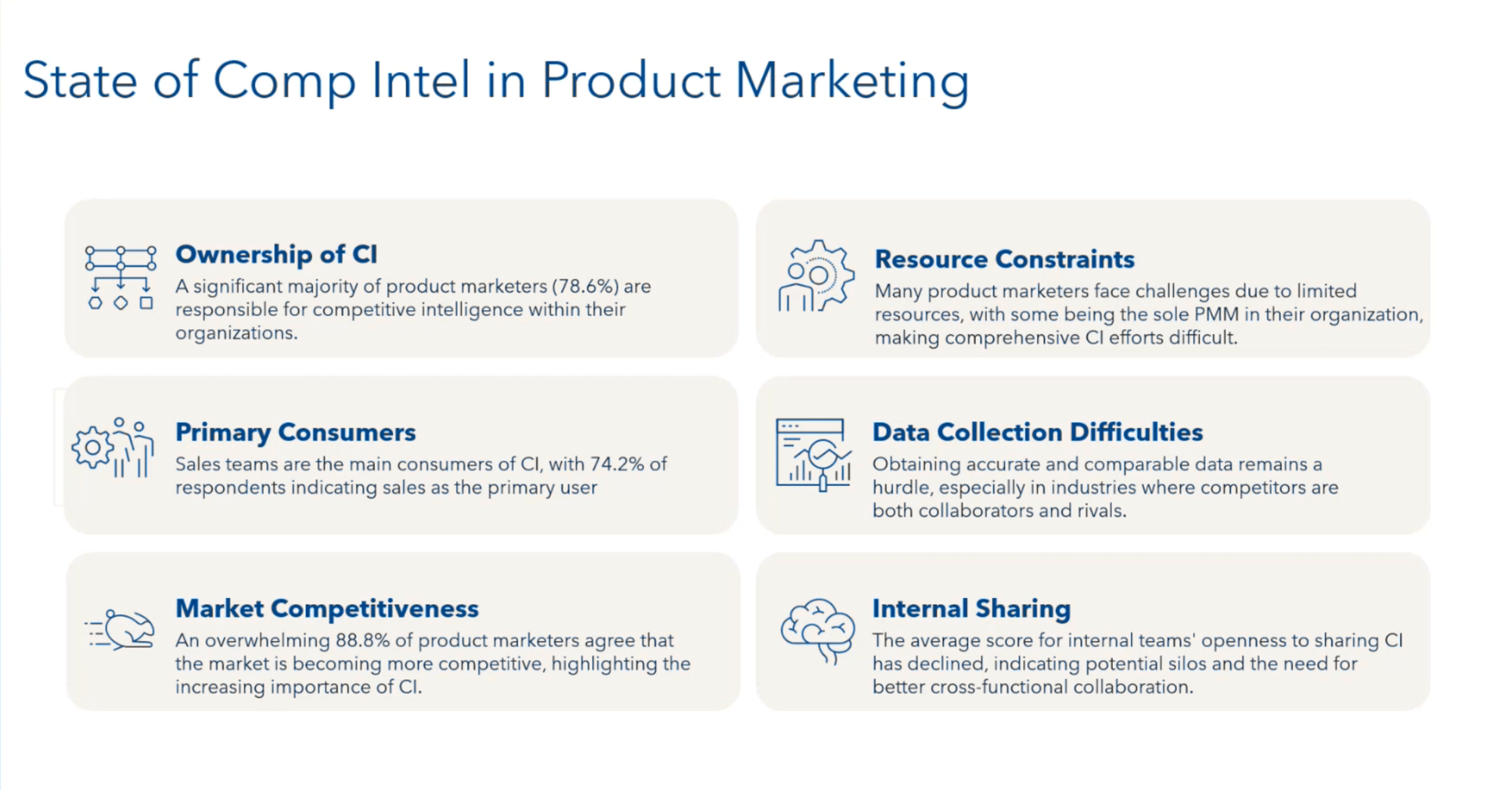
All of this is happening in an increasingly competitive market. Almost 90% of PMMs say their industry is getting more competitive – shorter deal cycles, crowded categories, and leaders pushing for sharper positioning.
Even when we do gather strong insights, sharing them effectively remains a major hurdle. Silos are growing. Teams are protective of data. Without intentional enablement, insights sit in documents – or get repeated in multiple, misaligned versions.
On top of that, data collection itself is getting harder, especially in SaaS, where today’s competitor could be tomorrow’s partner or acquirer. It’s not just about collecting facts. It’s about interpreting signals in a dynamic, often ambiguous landscape.
This is the reality: product marketers own CI, sales needs it yesterday, resources are limited, and pressure is rising – which is exactly why ethical, strategic, and well-structured competitive intelligence matters more than ever.
Your superpower isn't just gathering intel – it's doing it right
The pressure on product marketers to deliver competitive intelligence is intense. Sales wants real-time intel to win deals. Leadership wants strategic clarity to guide decisions. Everyone wants it fast.
But here's the thing: that pressure isn't a burden. It's a signal. It's telling you just how critical your role is. The organization needs the intel you provide. The challenge is making sure that intel is credible, ethical, and scalable.
That's where your superpower comes in. You don't just gather scraps from the internet. You create a system – one rooted in ethics, integrity, and insight.
You use tools like a competitive intelligence charter to define the boundaries. You filter requests through the traffic light system and the FAIR framework. And instead of chasing gossip, you deliver reliable, insightful, boardroom-ready intelligence.
When you do that, you become more than just the PMM responsible for competitive intelligence on top of a slew of other things. You become the trusted voice in the room – the person who enables deals, shapes strategy, and builds confidence across the organization.
So, let’s dive into three frameworks that’ll help you gather intelligence the right way.
Framework #1: The competitive intelligence charter
One of the most important moves you can make is to create a competitive intelligence charter and get legal to sign off on it.
Think of this as your CI program's terms and conditions. It's a clear, approved framework that defines what you will and won't do, and how your company conducts competitive intelligence ethically.
This document protects you, and it gives you a professional, credible way to say no when somebody asks for something that crosses the line. Instead of debating, you simply say, “That's outside of our charter.” And if someone pushes, you can pull in legal and have that conversation together.
Ideally, you create the charter before you need it – before the urgent sales request for confidential roadmap intel, before someone suggests you pretend to be a prospect and get a demo. If you don’t have a charter yet, build one now. It’s never too late.
The five core components of your CI charter
Your competitive intelligence charter should include five core components:
- Objectives: Why are you doing competitive intelligence? What's it enabling? Who does it support? How does it tie to revenue and strategy?
- Scope: What types of data will you gather and from where? Define acceptable sources (public sites, analyst reports, win/loss interviews) and how you will not gather CI (e.g., by impersonating a prospect).
- Methods: What's acceptable versus unacceptable? Use the traffic light framework outlined below.
- Roles: Who can request intel? How should they do it? What's the intake process?
- Escalation: If a request is questionable or pushes boundaries, where does it go next?
Together, these elements give you clarity, consistency, and protection when navigating ethical gray zones.
Framework #2: The traffic light framework
The traffic light framework is one of the most practical tools for ethical competitive intelligence.
It gives you a simple way to make fast, informed decisions – and the language to push back when something doesn’t feel right.
🟢 Green light practices
These are fair game. These are publicly available sources, so you can use them without any legal review or hesitation. Examples include:
- Pricing pages on competitor websites
- Publicly available analyst reports
- G2 and TrustRadius reviews
- Job postings
- Press releases
- Win/loss interviews from your own customers
- Public webinars and demos
These are the core of a strong, compliant CI program. They're useful, scalable, and risk-free.
🟡 Yellow light practices
These activities require pause, context, and sometimes a review from your partners in legal before you can go ahead. For example:
- Feedback from former employees: Yes, this feedback might be insightful, but you need to make sure it's anonymized and not subject to an NDA.
- Private LinkedIn, Slack, or Reddit communities: Again, maybe valuable, but proceed carefully, especially if group access is restricted.
- Customer intel about competitors: Was the customer under an NDA? If you're not sure, check.
🔴 Red light practices
This is where we draw a hard line. Red light practices are not only unethical – they're often illegal and can result in real consequences for you and your company. These include:
- Pretending to be a prospect to gain access to gated material
- Using leaked or confidential documents
- Encouraging customers to share NDA-protected info
- Paying someone for insider info
Even if it feels like everybody does it, don't. The reputational and legal risks are not worth it.
When in doubt, use this framework alongside your charter. It’s a fast way to gut‑check requests and set clear boundaries.
Framework #3: The FAIR model
If you take nothing else away from this article, let it be this: how you gather intel is just as important as what you gather.
The FAIR model is a simple, memorable framework to help keep your CI practices sharp, strategic, and most importantly, ethical. Let’s take a look.
F is for focused
Your CI should be laser-focused on the questions that drive your business:
- How do you win deals?
- Why do you lose?
- Where are you vulnerable?
- What are your true differentiators?
This isn't about collecting trivia or hoarding data. It's about answering the questions that matter.
A is for accurate
You must verify claims before repeating them. One competitor slide, one Reddit post, or one offhand customer comment? Not enough. CI only earns trust when it's credible.
I is for insightful
Always move from the “what” to the “so what.” This is the difference between reporting and enabling.
Don't just say, “Our competitor added a new feature.” Say “This feature closes the gap that helped us win twelve deals last summer – here's how to reposition against it.”
R is for responsible
This is where ethics come in. No shortcuts. No sketchy sourcing. No gray area tactics. You're not just representing your company; you're setting the tone for how your brand behaves in the market.
When in doubt, do a quick gut check. Would you feel confident sharing this intel source in a board meeting? Would you be happy to see this in a press article? Are you treating competitors with the same integrity you’d expect from them?
If the answer is no, then it's not FAIR.
The bottom line
Product marketers often serve as the moral compass of go-to-market. We sit across sales, product, brand, and the customer – and how we handle competitive intelligence sets the tone.
The pressure won’t disappear, and the requests will keep coming. But with the right tools, frameworks, and conviction, you can respond with integrity.
Ethical competitive intelligence isn’t just about avoiding risk. It’s about building trust, earning credibility, and creating a competitive advantage that can’t be copied. That’s your superpower – use it wisely.
This article is based on Lanie Schenkelberg’s brilliant talk at the Competitive Intelligence Summit, 2025.

.png?v=1a9131b19b)