


Do you wake up every morning excited to manually update your battlecards? Do you rush to your computer, just praying that there are 50 identical questions from sales reps waiting in your Slack inbox?
I’m guessing not. Yet, for many competitive intelligence (CI) professionals, that’s the reality.
Traditional CI has always been brutally manual. You read a lot, you write a lot, and then you spend an enormous amount of energy trying to get people to actually read what you've written. You fight a constant uphill battle to keep content current. And after all of that effort, adoption remains stubbornly low.
It's not that the people running competitive intelligence programs aren't talented or hardworking. It's that the model itself is fundamentally broken.
The good news is that there's a better way. And in 2026, that better way is automated CI.
What automated competitive intelligence actually means
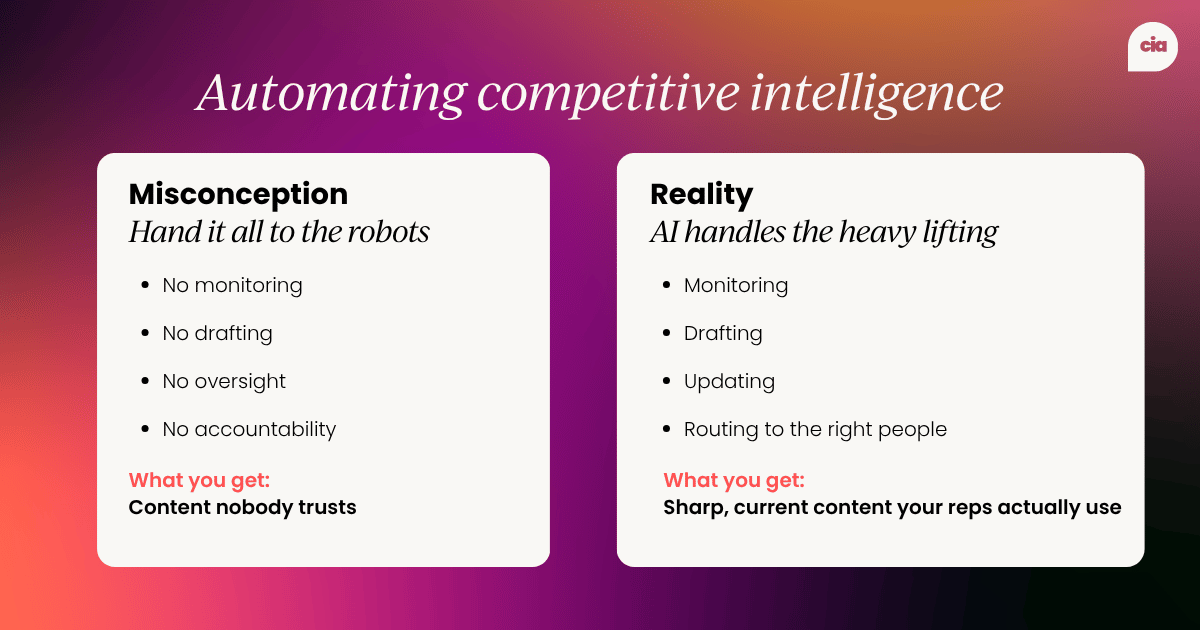
Let's quickly address a common misconception: automated CI doesn't mean you hand everything over to the robots and walk away.
What it means is that AI handles the heavy lifting: the monitoring, the drafting, the updating, the routing of information to the right people at the right time. You shift from being someone who manually produces everything to someone who sets up the system, feeds it the right inputs, and makes sure the outputs are sharp.
14 times. That's the adoption boost we're seeing across companies running CI this way, compared to traditional programs. Whatever your current adoption looks like, whatever your current impact is, that number should make you stop and think. What would it take to get there?
That's what I want to walk through.
Start with the data you're feeding your AI
The single most important question for a competitive intelligence leader running an automated program is this: what data are you feeding your AI?
It sounds almost too simple, but it's everything. You can have the best AI tools in the world, the best downstream delivery mechanisms, the most sophisticated chatbot your sales team has ever seen. None of it matters if the information going into the system is weak.
Most competitive programs default to external data. The competitor's website, their product announcements, their pricing pages, their press releases, their job postings. You absolutely need that stuff. Tracking M&A activity, product launches, messaging shifts, help documentation changes – all of it matters. Don't stop doing it.
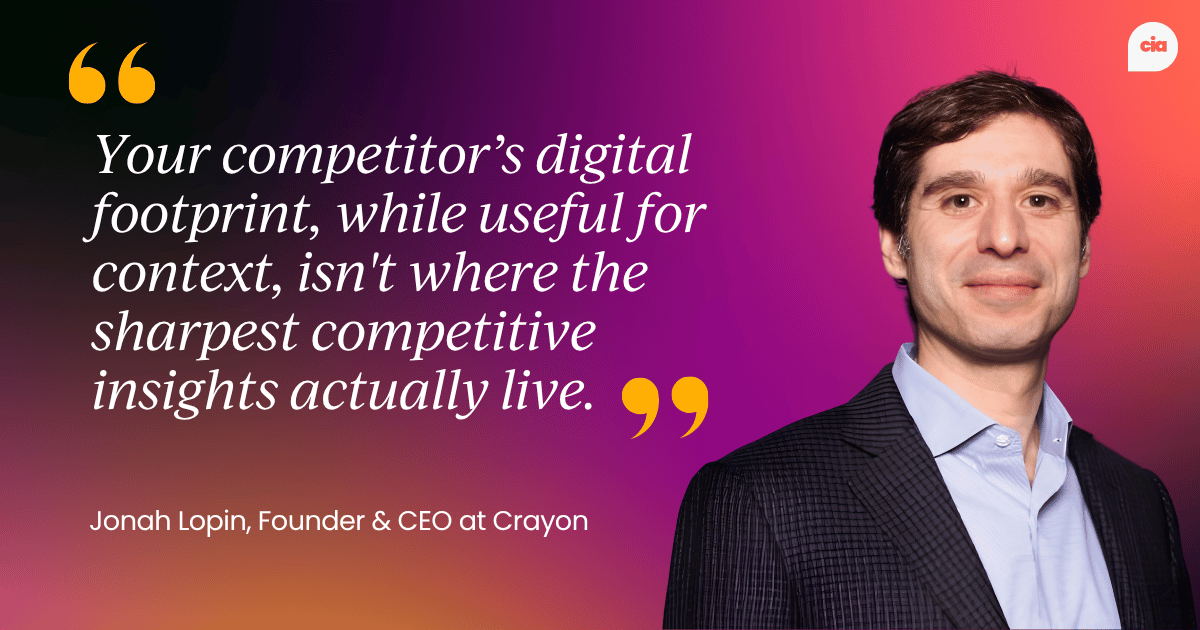
But here's where a lot of programs get stuck: they over-index on external data as if it were the primary source of competitive intelligence. The problem is that your competitor’s digital footprint, while useful for context, isn't where the sharpest competitive insights actually live.
Think about what your sales team really needs. They need the most effective talk tracks against specific competitors. They need to understand the objections that are coming up in live competitive deals. They need to know what buyers are saying, in their own words, about why they're considering switching or staying.
That kind of intelligence doesn't live on a competitor's website. It lives inside your own organization.
The internal data sources most programs overlook
This is where automated competitive programs really start to pull ahead of traditional ones. The best programs aren't just scraping the web. They're tapping into enterprise data – the conversations, calls, and internal knowledge that most competitive teams ignore.
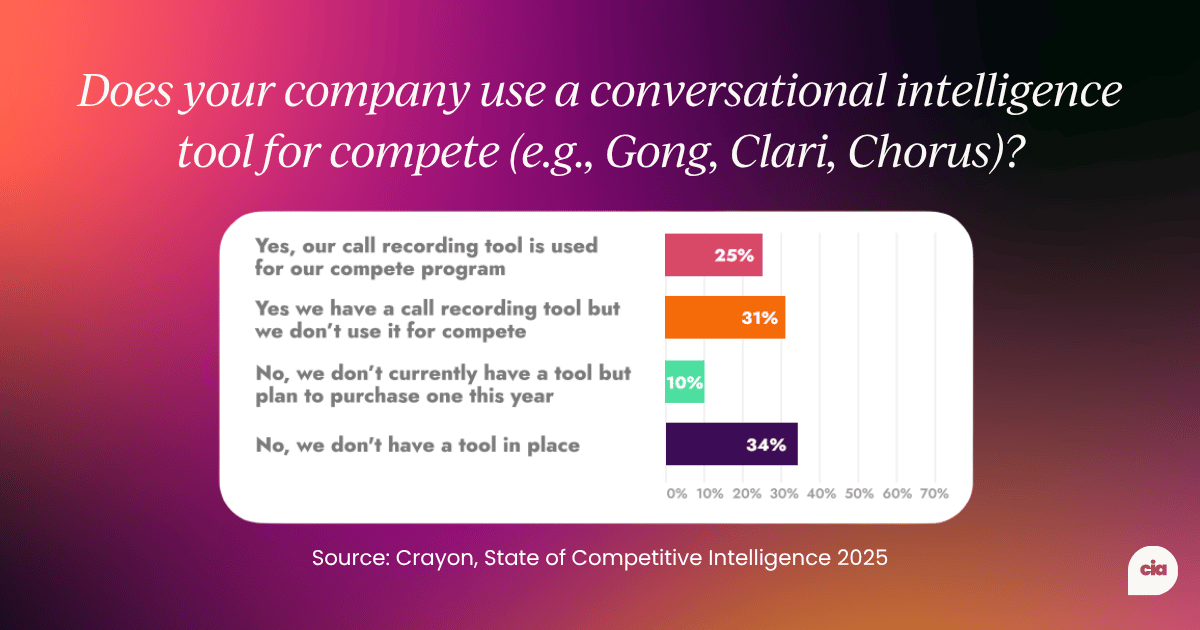
The most obvious source is sales call recordings. These are gold mines of real competitive intelligence. They’re packed with actual buyer language, objections, and competitor claims that are landing in the market right now.
Our latest State of Competitive Intelligence report found that teams using call recording tools for CI increase sales effectiveness by 82%. And yet, only 25% of companies are feeding call recordings and transcripts into their competitive AI.
The second key source is one I think is even more undervalued: internal experts. Ask yourself: who at your company knows the most about your top competitor? Who wins competitive deals almost every time? Who can articulate your differentiation so clearly that it changes how reps think about positioning? Who has been living and breathing this competitive battle for years?
Those people exist at almost every company, and most competitive programs never formally capture what's in their heads.
Go sit down with them. Record the conversation. Run it through a transcription tool. Extract their talk tracks, their mental models, their instincts about where competitors are vulnerable. Feed that into your AI. The quality of everything your program produces will jump noticeably.
Only about 18% of companies are doing this. Which means if you start, you're immediately ahead of the vast majority of your peers. That's a meaningful advantage, and it doesn't require any sophisticated tooling to get started.
Teaching your AI isn't a one-time event
Once you've sorted out your data sources, you need to think about how you set up your AI to use that information well.
This requires some investment upfront. You can't just throw a prompt at an AI and expect it to produce competitive content that's useful for your sales team. You have to educate it. You have to give it a real grounding in your value proposition, sales process, market dynamics, and your positioning.
Think of it like onboarding a new team member who's extremely capable but knows nothing about your business yet. Just like a new team member, that education doesn't stop after orientation. You have to keep patiently teaching it.
When your AI produces outputs that aren't quite right, you correct them. The correction isn't just about fixing that one piece of content. It's about making sure that feedback loops back into the AI's understanding so the next output is better.
This is a meaningful shift in how most of us think about our roles in competitive intelligence. You're not just editing and shaping content anymore. You're editing and shaping the system that creates the content. That's a different skill set, and it's worth developing deliberately.
Finding the right balance between automation and human judgment
There's a spectrum here, and where you land on it matters.
On one end, you have full manual control. You write everything by hand. You review everything before it goes out. You're the quality filter for every piece of content.
On the other end, the AI is largely running the show. It's publishing updates, routing intelligence, and generating content with minimal human review.
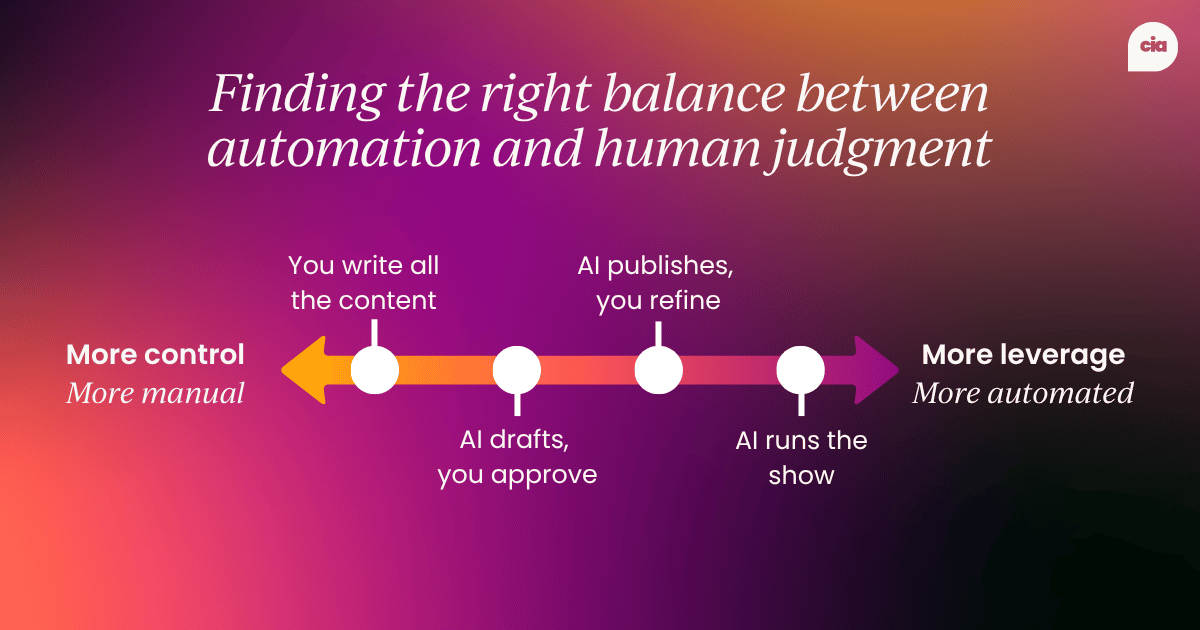
Neither extreme is right for every program or every piece of content.
The most practical approach is to think about this at a more granular level. For your tier-three competitors, you might decide to automate almost everything. The volume of content doesn't justify significant manual effort, and the stakes of an imperfect output are relatively low. For your tier-one competitors, you probably want more hands-on involvement.
Even within your tier-one competitors, it's worth thinking through which specific content warrants careful human attention. Your core positioning against your most important competitor – the talk track that reps use in the most critical deals – probably deserves to be handcrafted. Every word matters there.
But the company profile for that same competitor? That can almost certainly be automated. Objection handling libraries, competitive quotes, market context – much of that can be generated and maintained by AI with periodic human review.
The key is being intentional about these choices rather than defaulting to one approach across the board.
Where your competitive content needs to show up in 2026
Now that you have an idea of how you should be producing your competitive content, the question is where to share it?
Almost every seller today starts almost every workflow in an AI tool. They're using Copilot, Claude, Gemini, or some internal agent built on top of one of these platforms. They're doing deal prep in AI. They're drafting emails in AI. They're researching prospects in AI. If your competitive content isn't surfacing inside those AI experiences, it might as well not exist.
There's almost certainly an AI enablement initiative happening at your company right now. Someone is building an agent, rolling out Copilot, or deploying some kind of AI-assisted deal prep workflow. Your job as a competitive intelligence leader is to make sure your content hooks into those experiences, whether that’s via an API, an MCP, or however the technical connection needs to happen.
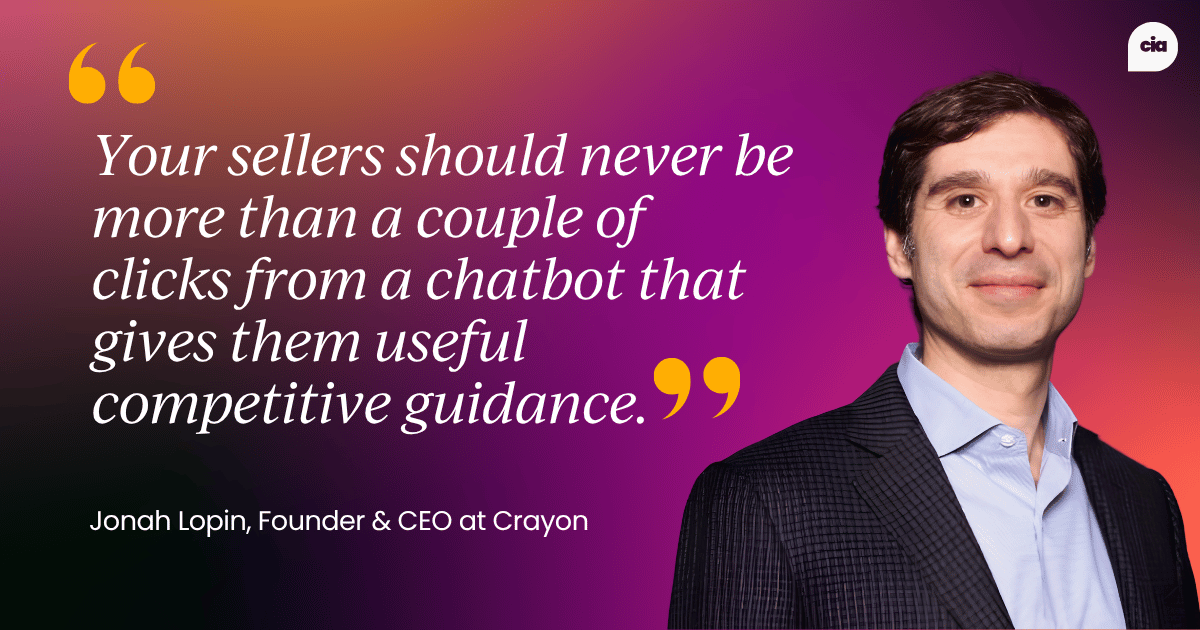
Your sellers should never be more than a couple of clicks from a chatbot that gives them useful competitive guidance. That's the standard to aim for. If your AI enablement team is building a solution for Salesforce but not for Slack, fine – plug your competitive content into the Salesforce solution and drop your own chatbot into Slack.
The specific implementation matters less than the outcome: competitive intelligence that's accessible, in context, when reps actually need it.
The battlecard that lives in a folder somewhere, the wiki that requires three clicks and a search query to find – those aren't getting used. A chatbot that surfaces the right information at the right moment, inside the tools sellers are already using, is a completely different story.
A note on prompt quality
One thing that often gets overlooked when you're rolling out competitive chatbots is that not everyone prompts the way you do. You've probably developed some prompt engineering skills. Your sales reps haven't necessarily done the same.
What this looks like in practice is single-word queries, misspellings, and vague requests that don't give the AI enough context to return something useful. This is normal. It's just how people interact with these tools when they haven't been coached.
There are two things you can do about it:
- Train your sales team: Give them concrete examples of good prompts. Show them the difference between typing "Microsoft" and asking "what are our strongest talking points against Microsoft in a deal where security compliance is the buyer's main concern?" That kind of coaching pays dividends quickly.
- Build context into your chatbot: Wrap the user's query with additional context via a system prompt. If the AI knows who's asking, what deals they're working on, and what stage those deals are in, it can compensate for a vague prompt and still return something genuinely useful.
Push intelligence to reps before they know they need it
Chatbots are a pull mechanism. Someone has to think to ask a question. And in the middle of a busy quarter, with a pipeline full of deals, reps don't always think to ask.
That's why you have to push CI, too. Proactive delivery of competitive intelligence – alerts, updates, relevant news – keeps your program visible and keeps reps informed without requiring them to seek it out.
The critical thing with push, though, is context. If a rep is deep in a deal against one competitor and you push them a news alert about a completely different competitor, that's not helpful. Over time, these kinds of unhelpful updates train people to ignore what you send.
Whatever agents you're using to push intelligence out, they need to understand the context of the person they're pushing to: what deal that person is working on, which competitor is in play, and what stage things are at. The more targeted the push, the more useful it is. And the more useful it is, the more your program gets used.
Now is the moment to automate your CI
The clock is running out on doing competitive intelligence manually. A year from now, the competitive enablement programs that are winning are going to be automated, and that gap between automated and manual programs is only going to widen.
You want to be among the first in your industry to make that shift, not one of the last still updating battlecards by hand. The results are impressive when you make the transition:
⭐ More competitive wins
⭐ More sales rep engagement
⭐ More influence inside your organization
Plus, it's more fun. When you're not spending your days on manual updates that nobody reads, you get to focus on the parts of the job that need real judgment: the strategic insights, the expert interviews, and the positioning calls that shape how your company competes.
This article is based on Jonah Lopin’s insightful talk at the 2026 Competitive Intelligence Summit, hosted by Product Marketing Alliance.

.png?v=9NcA-Rkt22NTrJVL)